
Challenges (and Opportunities) for Documentary Storytellers Around the World
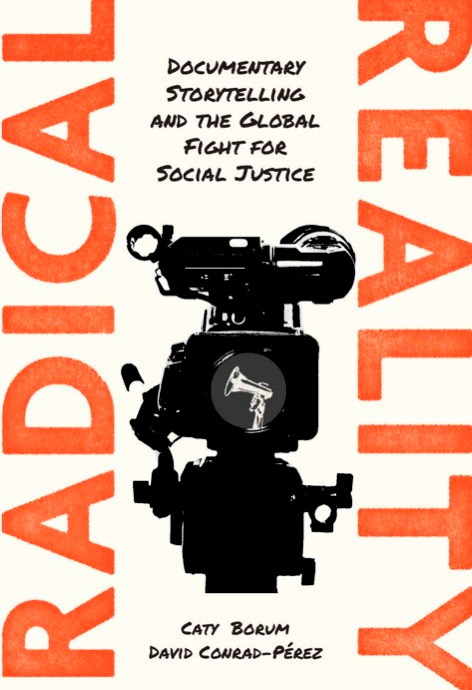
An excerpt from the book "Radical Reality," introduced by co-authors Caty Borum and David Conrad-Perez.
With public media funding under attack, newsrooms (and late-night shows) shuttering, algorithms shadow-banning, distribution powers consolidating, etc. etc. it can feel like censorship (especially for documentary films) is a new crisis. It's not. Independent filmmakers have always battled commercial and political gatekeepers. And throughout history, good, important, mind-expanding stories have found their way to audiences, even with powerful forces working against them.
The excerpt below, from Radical Reality: Documentary Storytelling and the Global Fight for Social Justice by Caty Borum and David Conrad-Perez, tells the story of An Insignificant Man, an Indian political documentary that faced government censorship in 2017. As you’ll read, An Insignificant Man did ultimately get its audience. The excerpt offers a peek into how documentary censorship manifests globally and why building direct audience relationships matters more than ever.
This is a sucky time with many serious challenges, but my hope is that this excerpt (and perhaps the book itself) gives you more conviction that your work is needed and that these times are not insurmountable.
A note from the authors:
By Caty Borum and David Conrad-Perez
At this point, multiple independent studies have confirmed the global trend: democracy is on the decline around the world, authoritarianism is on the upswing. Not surprisingly, press freedom indexes have found an unprecedented, coinciding clamp-down on freedom of the press and freedom of expression indicators in countries that were once global leaders of independent media. Meanwhile, a relatively small cohort of commercial distributors, and the logics of global capitalism that motivate them, are in charge of the vast majority of documentaries that are distributed in the U.S. and around the world. And since human rights stories are increasingly seen as market disruptors, this means that vital stories that feature underrepresented communities and dissenting opinions, and those that stand to challenge the status quo, are having to battle both global censorship trends and commercial market barriers to get their films seen.
This is a reality that became increasingly clear to us over the last few years at the Center for Media & Social Impact, where we are dedicated to the study and showcasing of media for social impact. Since 2022, we have interviewed more than 200 documentary filmmakers and documentary professionals working around the world — the similar challenges and experiences they shared, across countries, is at once alarming and inspiring.
To help bring focus and attention to their stories, we were inspired to craft a new book, Radical Reality: Documentary Storytelling and the Global Fight for Social Justice, published this year by Oxford University Press. In this work, we have done our best to provide an accounting of the promise and struggle of documentary today — and, importantly, why we need truth-telling nonfiction storytelling so desperately. We are hopeful that it will serve both helpful in advocating for urgently needed change and conversation in the industry, and as one small attempt to lift up the power and importance of documentary to a wider audience.
Courtesy of our publisher, Oxford University Press, an excerpt from Radical Reality follows.
An excerpt from Radical Reality:
In 2016, the acclaimed Indian political documentary An Insignificant Man premiered at the prestigious Toronto International Film Festival. It was a critical hit, astonishing viewers with its intimate access to political figures and its open showcase of public dissent—reflections rarely seen in mainstream Indian news. In observational form, the documentary follows the real-time developments of what became a crucial moment for the country’s democracy in 2013—the political rise and impending dominance of the right-wing religious Hindu-nationalist party, Bharatiya Janata Party (BJP), a restless uprising sparked to life within pockets of India’s multiethnic, multireligious populace. A new collective voice clapped back—the Aam Admi Party (AAP), or “Common Man’s Party”—and its founding leader, politician Arvind Kejriwal, didn’t demur in criticizing the corruption he saw in the country’s two major political parties.
As directors Khushboo Ranka and Vinay Shukla said in press interviews at the time, Kejriwal and his AAP provided a jolt of energy for prodemocracy Indian citizens who responded to his calls to fight malfeasance and shed light on perceived murky political machinations. Within a political system that is, as the filmmakers characterize it, “extraordinarily opaque,” the documentary reveals it all, despite the impossible odds stacked against this kind of critical, in-depth storytelling in India. By the time Ranka and Shukla were ready to launch the film in their own country, the BJP had become the dominant party under India’s Prime Minister Narendra Modi, the right-wing stalwart elected in 2014.
But in an unanticipated twist, the Indian government stepped in to block the film. In 2017, the country’s national censor, the Central Board of Film Certification (CBFC), refused to provide the official certificate required to distribute the film in India—that is, unless the filmmakers removed all references to BJP and Congress, and unless they also received written permission from Prime Minister Modi and the titular figure Kejriwal, the activist politician pushing for change. Ranka and Shukla knew the proposed changes to the film would be catastrophic. In neutered form, it would be useless as an authentic eyewitness to a meaningful political moment.
The tide only turned after the directing team launched a social media campaign in protest, vocally amplified by the International Documentary Association and others, when India’s Film Certification Appellate Tribunal (FACT) finally cleared the film for release. But there was still another hurdle to pass: the country’s highest court. By the end of the year, the Indian Supreme Court ruled in favor of the film and freedom of expression, a crucial moment for directors Ranka and Shukla and for documentaries that would follow. The decision was a pathbreaking precedent for nonfiction storytellers working within the country’s media censorship system. With its notoriety well-established due to the controversy, An Insignificant Man opened immediately in India, blasting open a rare window to witness political resistance and opposition in the country.
For its makers, the film was a turning point. As codirector Vinay Shukla said years later in an interview for this book, he was motivated by idealism for his country when he began, and he was even more compelled by the nonfiction form when the commotion was all over. His original compulsion—tell true stories that speak truth to power in some way—was even stronger:
That film gave me the opportunity to explore idealism, to understand what happens when a new political party full of idealism enters the current system of politics. What are the challenges that it faces? How does it deal with it? What kind of impact does the party have on the political culture and vice versa? And I was also constantly thinking about the larger question of how we should be framing our politics. But I went into that film with an inherent lens of being excited about idealism. When the film came out, because Khushboo and I faced so many challenges, our idealism had taken a solid beating on the release of that process. . . . But I was also pushed to a space wherein I was suddenly questioning, I was in a new phase in life wherein I began to contemplate what my role as an author is in the society around me. Because India currently is, without a doubt, going through a massive phase of transformation. . . . When I decided to make films, I really wanted to make them because I thought films can change the world and make it a better place. It’s very, very idealistic. And it’s in my core DNA.
The story of An Insignificant Man exemplifies the motivations, opportunities, and constraints facing a tenacious network of global documentary makers and film organizations fighting for social justice—transparency, right to dissent, anticorruption, freedom of expression, human rights—against tides of increasingly oppressive climates that often seek to silence inconvenient voices of protest or uncomfortable narratives of reality. The film’s battle against censorship and its hard-won legal victory would be notable in nearly any juncture, but it may seem particularly salient today, especially if we peer more closely at the bigger picture. In 2019, India, the world’s largest democracy, dramatically plummeted nearly 10 places on the annual global Democracy Index report—a compilation published by The Economist that ranks democratic functioning based on indicators including an open press, freedom of expression, and activities of civil society—landing in the bottom half of the second-tier, “flawed democracy” category, where the United States also resides. As the report noted, “the primary cause of the democratic regression [in India] was an erosion of civil liberties in the country,” and its government’s tendency to silence media references to taboo topics. While this is a particular story within a specific political context, it echoes in other corners of the world, in liberal democracies and authoritarian climates alike. And yet, it only begins to reveal the dynamic opposition and increasing pressures that documentarians face.
Radical Reality: Documentary Storytelling and the Global Fight for Social Justice reveals how and why independent documentary makers around the world are producing nonfiction film and TV programs that reveal hidden or neglected stories and fight for social justice, how they collaborate with supportive civil society organizations and activists to amplify their efforts, and why contemporary documentary storytelling matters for social change and progress in a global context. The book’s stories spotlight documentary’s place in the participatory media era and its challenges for an evolving future: surveillance technology, misinformation, suppression of free speech, consolidated commercial media systems, and other constraints. In countries around the globe, documentary films like An Insignificant Man are standing for freedom of expression, serving as witnesses to conflict and resilience, maintaining cultural memory of human rights abuses, and opening intimate windows into acts of protest, activism, reconciliation, and resistance that often go unseen in dominant news and other media portrayals. They are pushing against boundaries of oppression, centering underrepresented communities and leaders, providing spaces for community healing and recognition, and challenging authoritarian narratives that dispel controlled and often inaccurate portraits of people and their problems and triumphs.
And they are doing so in significant times. In disparate places, including within democracies historically lauded for their support of various freedoms, governments are ramping up forms of repression against those who would challenge power—independent media and journalists, civil society organizations that collectively advocate for the public interest, and ordinary people who speak out as activists. The trends are inseparably intertwined: a rise of authoritarianism around the world, increased clamp-downs on civil society, and media systems shuttering access and distribution. And yet, there is hope and power found in the hands of storytellers and activists who marshal a way forward, again and again, to push the status quo toward justice with a story-centered approach, armed with the tools and networks afforded by the participatory media age. This book shares their stories.
From Radical Reality: Documentary Storytelling and the Global Fight for Social Justice, by Caty Borum and David Conrad-Perez (Oxford University Press), “Chapter 1: Fighting the Good Fight Around the World” (pp. 1-6). Excerpt published with permission of Oxford University Press.
About the Authors:
Caty Borum is Executive Director of the Center for Media & Social Impact (CMSI), a creative innovation lab and research center based at American University in Washington, D.C., where she is also Professor in the School of Communication. Borum is an award-winning documentary producer and engaged scholar who works at the intersection of creative storytelling, communication, and social justice. Her first book, A Comedian and An Activist Walk Into a Bar: The Serious Role of Comedy in Social Justice, with co-author Lauren Feldman (foreword by Norman Lear), was published by University of California Press (2020) as the launch of the first Communication for Social Justice Activism series. Her second book, Story Movements: How Documentaries Empower People and Inspire Social Change, published by Oxford University Press (2020), was recognized with the 2021 Broadcast Education Association Book Award, and her book The Revolution Will Be Hilarious: Comedy for Social Change and Civic Power (NYU Press), was published in 2023 by NYU Press as part of the Postmillennial Pop Series. A former philanthropy director and producer with legendary TV producer and activist Norman Lear, her peer-reviewed research on the intersection of storytelling, creativity and social change is featured in leading journals in communication and the humanities, including Journal of Communication; Journalism; Media, Culture & Society; Journal of Broadcasting & Electronic Media; Mass Communication and Society; International Journal of Communication, and more.
David Conrad-Perez is research director at the Center for Media & Social Impact at American University. His work focuses on the intersection of journalism, social justice, community organizing, and media history. Before joining CMSI, he worked as a producer for WNYC’s On the Media and he has reported stories for news outlets that include the Los Angeles Times, New York Times, Reuters, San Francisco Chronicle, and PRI’s The World. He has a Ph.D. from the University of Pennsylvania’s Annenberg School for Communication (2018), with a critical focus on the history and influence of charity and philanthropy in the field of journalism. His research has appeared in several of the country’s leading academic journals on the media, and he has served as an invited documentary screening committee member for the Peabody Awards, in the documentary category, since 2018.
If you’re finding this newsletter valuable, share it with a friend, and consider subscribing if you haven’t already.
Very cool!